
It’s Sunday evening, and your stomach is already in knots. Is that dread about the week ahead, or a general sense that something is wrong, no matter what’s on the calendar?
That question sits at the heart of burnout vs anxiety. The World Health Organization describes burn-out as a syndrome resulting from chronic workplace stress that has not been successfully managed, and does not classify it as a medical condition. Anxiety includes diagnosable conditions and can follow you anywhere.
Below you’ll find a quick two-column check, an explanation of why the two get confused, what helps each one, and what research says about neurofeedback, a gentle, non-invasive form of brain training.
A Quick Check
Read down both columns and notice which sounds more like you. This is not a diagnosis, just a way to start the conversation.
| Sounds more like burnout | Sounds more like anxiety |
|---|---|
| I feel drained and detached from my work | My mind races about many things, not only work |
| I’ve grown cynical or lost satisfaction in what I do | I feel restless, tense or on edge much of the time |
| I feel less effective than I used to | I notice physical signs like a racing heart or shortness of breath |
| My exhaustion is tied to work or caregiving demands | The worry follows me into evenings, weekends and sleep |
Most people see themselves in both columns. That’s normal, and it’s exactly why the two get mixed up.
What Burnout Actually Is
The WHO describes three dimensions: feelings of energy depletion or exhaustion, increased mental distance from your job or feelings of negativity and cynicism about it, and reduced professional effectiveness. It stresses that burn-out refers specifically to the workplace.
Mayo Clinic describes job burnout as a type of stress linked to work that can leave you worn out physically or emotionally, and sometimes feeling useless, powerless or empty. It lists several common causes:
- Little control over how you do your job
- Unclear expectations
- Conflict with others
- Too much to do, or too little
- Lack of support
- A work-life balance that has tipped too far

Why the Two Are So Easy to Confuse
Burnout and anxiety share a lot of ground: trouble concentrating, poor sleep, irritability, low energy and physical complaints such as headaches or stomach trouble. Chronic stress can feed anxiety, and anxiety can make stress harder to shake.
Anxiety itself is a feeling of worry, unease or fear, often with physical symptoms like a racing heart. It becomes a clinical concern when it’s frequent or intense and gets in the way of daily life.
Mayo Clinic also points out that burnout can raise the risk of depression, and that depression and burnout are different and need different treatments. That’s one more reason to have a professional help sort out what’s going on instead of guessing.
When It’s Both, or More: Who to Call
Talk with a doctor or mental health professional if you notice:
- Exhaustion, worry or low mood that isn’t lifting
- Panic attacks, chest tightness or a racing heart that is frequent or worrying
- Weeks of trouble sleeping, eating or concentrating
- Alcohol, food or other substances becoming a way to numb or cope
- Headaches, stomach problems or other physical symptoms with no clear cause
If you ever have thoughts of harming yourself, call or text 988 (the Suicide & Crisis Lifeline) or go to your nearest emergency room right away.
What Helps Each One
If it looks like burnout
Mayo Clinic suggests looking at your options, including talking with your manager about workload and expectations and setting realistic goals. It also recommends seeking support from co-workers, friends or family, trying a relaxing activity such as yoga, meditation or tai chi, getting regular exercise, protecting your sleep and practicing mindfulness.
If it looks like anxiety
Talk therapy, such as cognitive behavioral therapy (CBT), helps many people change how they respond to worry. Your doctor may also discuss medication when appropriate. Calming skills like slow breathing can help in the moment.
If it’s both
Start with a professional evaluation, so that the workplace piece and the health piece can be addressed together.

Where Neurofeedback Fits
Neurofeedback works like a live feedback loop. Sensors on the scalp read your brainwaves, the brain’s natural electrical rhythms, and the show or music you’re watching responds as your patterns shift. Over many sessions, your brain practices calmer, more regulated patterns.
Most of the research relates to anxiety rather than burnout. A 2021 meta-analysis of 26 neurofeedback trials found that self-reported anxiety scores dropped by nearly one standard deviation, a sizable drop across the studies it pooled. The review notes that its findings are limited to white adults with anxiety or PTSD symptoms, so they may not apply to everyone. Research on neurofeedback specifically for burnout appears limited.
The takeaway: encouraging for anxiety, thin for burnout, and not a cure for either. Neurofeedback can’t promise results, and it works best alongside rest, boundaries at work and care from your doctor or a therapist.
At MyBrainDR, we offer neurofeedback for anxiety and panic attacks and for peak performance, which some people explore when stress is affecting their focus.
What to Expect at MyBrainDR
We have offices in Raleigh and Cary and serve women across the Research Triangle, including Durham, Chapel Hill, Apex and Wake Forest. Here is your first visit in plain English.
What happens first? A free, no-obligation, one-on-one conversation. Our team reviews your health history and current treatments and talks with you about whether neurofeedback could suit you. Book that evaluation here.
What’s the brain map? A quantitative EEG, or qEEG, is a non-invasive recording of electrical activity in different areas of your brain. The initial scan takes roughly 20 to 30 minutes, and it helps our team build a personalized training plan.
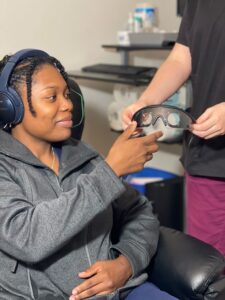
What are sessions like? About 30 minutes. You relax and watch a show or movie, or listen to music, while sensors track your brainwaves. When your patterns drift outside the target range, the picture or sound briefly dims or fades, and your brain gradually learns from that.
What else should I know? The number of sessions varies by person. Side effects are rare, though some people feel briefly tired or have trouble sleeping afterward. You don’t have to stop your medications, and at-home training is available after an in-office brain scan.
Burnout vs. Anxiety FAQs
Can burnout lead to depression?
It can raise the risk. Mayo Clinic notes that burnout can increase the chance of depression, though the two are different and need different treatments. If low mood, loss of interest or hopelessness lingers alongside exhaustion, talk with a doctor or mental health professional rather than waiting for it to pass.
Is burnout only about work?
By the WHO’s definition, yes: burn-out refers specifically to the workplace and shouldn’t be applied to other areas of life. Many people do feel the same drained, detached feeling around caregiving or other heavy roles, though. Whatever you call it, the feeling is worth taking seriously and talking about with a professional.
Can neurofeedback cure burnout or anxiety?
No. Neurofeedback is not a cure for burnout, anxiety or any other condition. It is a non-invasive training approach designed to support healthier brain regulation. Research suggests it may help some people feel calmer, but studies on burnout specifically appear limited, and results vary from person to person.
Name It, Then Choose Your Next Step
Getting the label right helps you choose the right kind of help. Whether it turns out to be burnout, anxiety or a mix, you deserve support that fits.
If you’re in Raleigh or nearby, Dr. Robert Baric and the rest of our team at MyBrainDR would be glad to meet you. Book your free in-person evaluation at MyBrainDR to talk through what you’re feeling and whether neurofeedback is worth exploring.
MyBrainDR, Two Locations
Six Forks in Raleigh 8388 Six Forks Rd. Suite 101 Raleigh, NC 27615
Cornerstone in Cary 270 Cornerstone Dr STE 101 Cary, NC 27519
Phone: (919) 721-4800
Office Hours: 8388 Six Forks Rd. 101, Raleigh 27615
M: CLOSED T: 7:00am – 6:00pm W: 11:00am – 6:00pm Th: 7:00am – 6:00pm F: 11:00am – 6:00pm Sat: 9:00am – 1:00pm
Office Hours: 270 Cornerstone Dr. 101, Cary 27519
M: 10:00am – 6:00pm T: 7:00am – 6:00pm W: 10:00am – 6:00pm Th: 7:00am – 6:00pm F: CLOSED Sat: 8:00am – 12:00pm
Disclaimer: This article is for general educational purposes only and is not medical advice. Neurofeedback does not cure or treat any condition, does not replace medical care, and results vary from person to person. Research on neurofeedback for anxiety and stress is still evolving. Always talk with your physician about your symptoms and before changing any treatment. If you are in crisis or having thoughts of harming yourself, call or text 988 or go to your nearest emergency room.